Quick answer
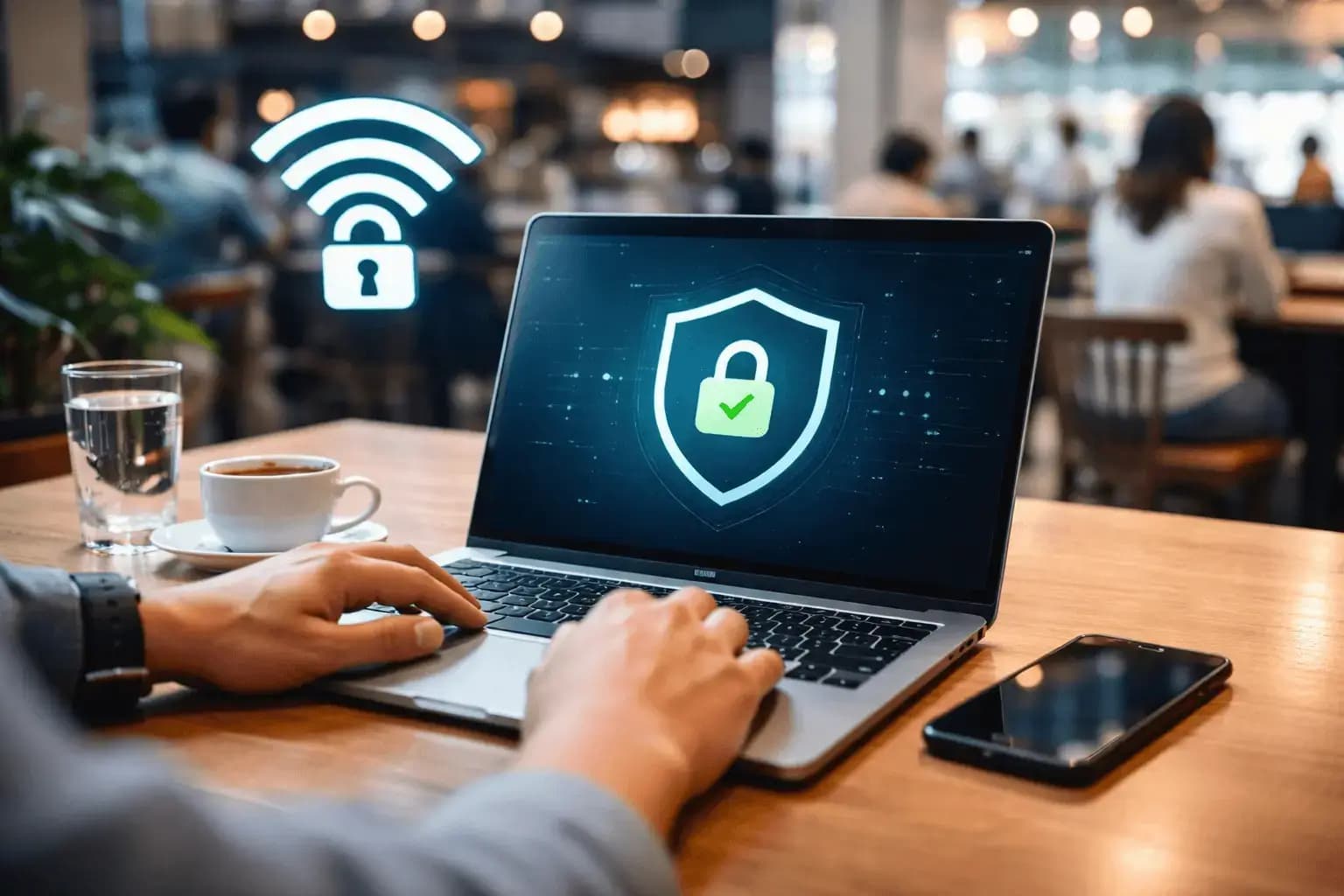
Public Wi-Fi is not the horror story of 2010 — HTTPS now protects the content of most sessions. But open networks still observe more than people think: every domain you resolve over DNS, connection timing and volume, your device identifiers, and captive portals still inject pages into your traffic. The fix is a short habit stack: keep systems updated, prefer HTTPS, and put an encrypted tunnel under everything before you log in to anything.
What an open network can actually see
When you join a hotspot, its equipment forwards all your traffic. Even with HTTPS everywhere, the network still learns:
- Your DNS lookups — the domain of every site and app you open, in plaintext, unless DNS is protected. This is the single biggest leak in the HTTPS era.
- Connection metadata — which hosts you talk to, when, how often, and how much data moves. Patterns identify services even without content.
- Device identity — hostname and network identifiers that make you recognizable across visits.
- Anything unencrypted — legacy apps, some IoT traffic, and the initial redirect before a site upgrades to HTTPS.
And the network is not just the router: on shared Wi-Fi, other clients share the medium, and cheap hardware in between may be misconfigured or compromised.
Risks that are real vs. overstated
Mostly solved by HTTPS: reading your passwords and messages off the air. If the padlock is intact and you do not click through certificate warnings, session content is protected.
Still real:
- Metadata profiling — DNS plus timing reveals your services, habits, and presence.
- Rogue and look-alike hotspots — an attacker-run network named like the venue's, in the perfect position to watch metadata and serve malicious portals.
- Captive portal injection — the sign-in system legitimately intercepts your first requests; poorly built ones mishandle or monetize that position.
- Old-fashioned shoulder surfing — no protocol fixes a stranger reading your screen on a train.
The habit stack
- Update before you travel. Most Wi-Fi-based attacks exploit known, already-patched bugs.
- Join the right network. Confirm the exact SSID with the venue; "forget" networks after use so your device does not auto-join look-alikes later.
- Portal first, tunnel second. Complete the captive portal sign-in, then connect the VPN before opening mail, banking, or work. Inside the tunnel, the network loses DNS lookups and traffic patterns — it sees one encrypted stream. ClickVPN resolves DNS through its own infrastructure, so the hotspot's resolver never sees your queries.
- Verify, don't assume. After connecting, the what-is-my-IP tool shows what networks can see; the leaks guide covers DNS and WebRTC checks.
- Protect the accounts too. A tunnel does not fix a reused password. Unique passwords (the generator is free) and two-factor auth cover the account layer.
Special cases worth knowing
- Hotel networks often segment poorly and throttle video; a tunnel restores privacy and prevents traffic-type shaping in one move.
- Coworking spaces are long-lived networks where metadata accumulates for months — the profiling risk grows with time, not just with sensitivity.
- Tethering through your own phone beats open Wi-Fi when signal allows, and a VPN behaves identically over mobile data.
FAQ
Is banking on public Wi-Fi safe with a VPN?
The combination of HTTPS (which banks enforce) plus an encrypted tunnel is a strong, layered setup for practical purposes. What remains your job: correct URLs, no certificate-warning click-through, and two-factor authentication.
Do I need the VPN if the hotspot has a password?
A password on the network only encrypts the radio link and gates entry — everyone with the café's password is still inside the same network. The tunnel is what separates your traffic from the room.
What if the network blocks VPN connections?
Treat that as information about the network. ClickVPN's modern transports are designed to work on restrictive networks; if a hotspot still blocks everything, prefer tethering for anything sensitive.